Automatic gates in Reno face a particular combination of stresses that most property owners do not think about until something stops working. The gate that closed smoothly in October starts dragging by March. The operator that ran quietly begins straining against resistance that was not there before. These are not random failures. They follow a pattern tied directly to how Reno’s climate acts on gate systems over time.
Understanding what actually happens to posts, hinges, tracks, and operators during Northern Nevada winters helps explain why some gates hold up for years while others develop problems every season. The mechanisms are straightforward once you see them, and they point toward what matters most in how a gate is built and maintained.
For property owners evaluating automatic gate systems or trying to diagnose existing problems, this breakdown covers the specific ways Reno’s freeze-thaw cycles and wind loads affect gate components and overall system performance. You can find more detailed information about automatic gate systems and options at our automatic gates resource page.
What Makes Reno’s Climate Hard on Gate Systems
Reno’s winter climate creates two distinct forces that work together against automatic gates. Neither one alone would cause the problems we see, but combined, they progressively compromise gate alignment and mechanical function.
The first is repeated freeze-thaw cycling. Reno does not stay frozen all winter. Temperatures rise above freezing during many days, then drop below freezing at night. This pattern repeats dozens of times through winter and shoulder seasons. Each cycle moves water into soil and concrete, freezes it, expands it, then releases it as it thaws. The cumulative effect matters more than any single hard freeze.
The second is wind. Northern Nevada experiences strong seasonal winds that apply lateral pressure to gate panels. A gate panel acts as a sail. The larger and more solid the panel, the more force transfers into posts, hinges, and operators every time the wind picks up.
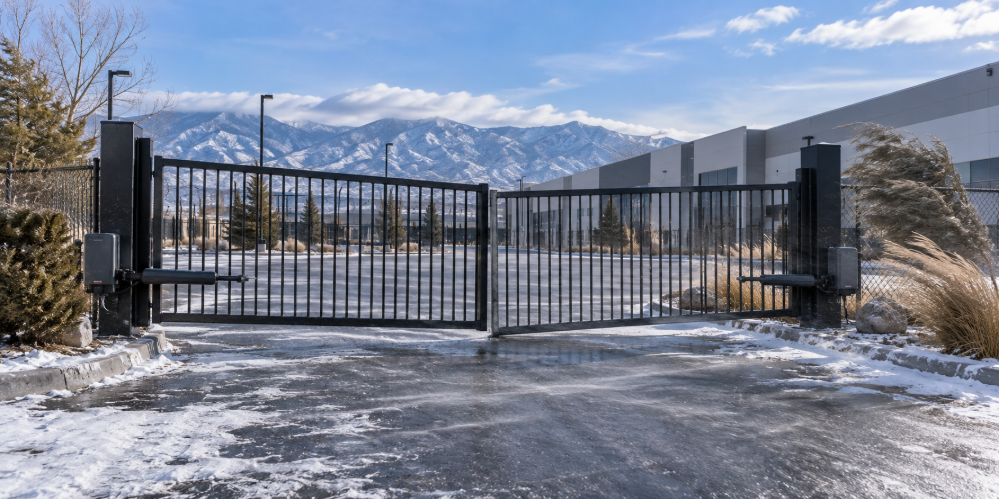
Snow and moisture exposure complete the picture. Winter precipitation introduces water into the ground around posts and footings, providing the moisture that freeze-thaw cycles need to do their work.
How Freeze-Thaw Damages Posts and Footings
The most consequential damage from freeze-thaw happens underground, at the posts and footings that support the entire gate system.
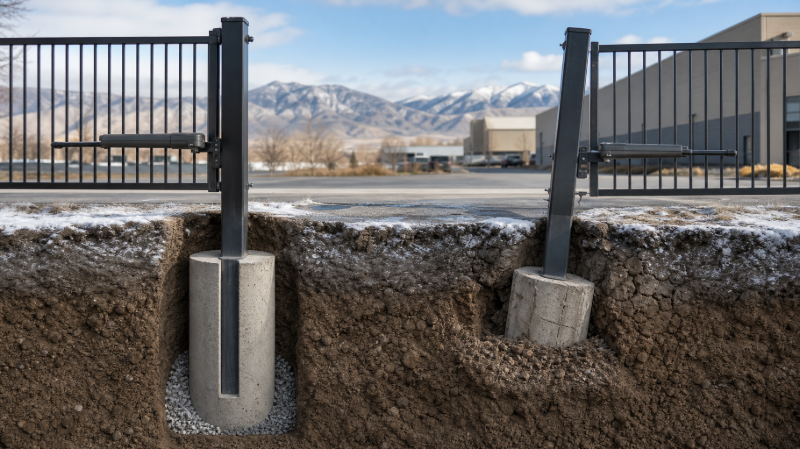
The mechanism works like this. Water enters the soil around gate posts and seeps into micro-cracks in concrete footings. When temperatures drop below freezing, that water expands as it becomes ice. The expansion pushes against the footing and surrounding soil. When temperatures rise and the ice melts, voids and loosened soil remain. The post can settle slightly at a new angle.
One cycle does not cause visible problems. But Reno experiences many cycles per winter, and each one can shift the post incrementally. Over several seasons, a post that started plumb develops measurable lean.
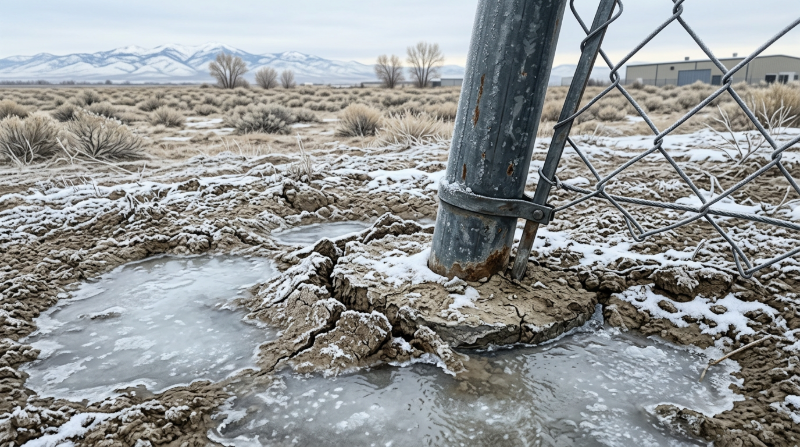
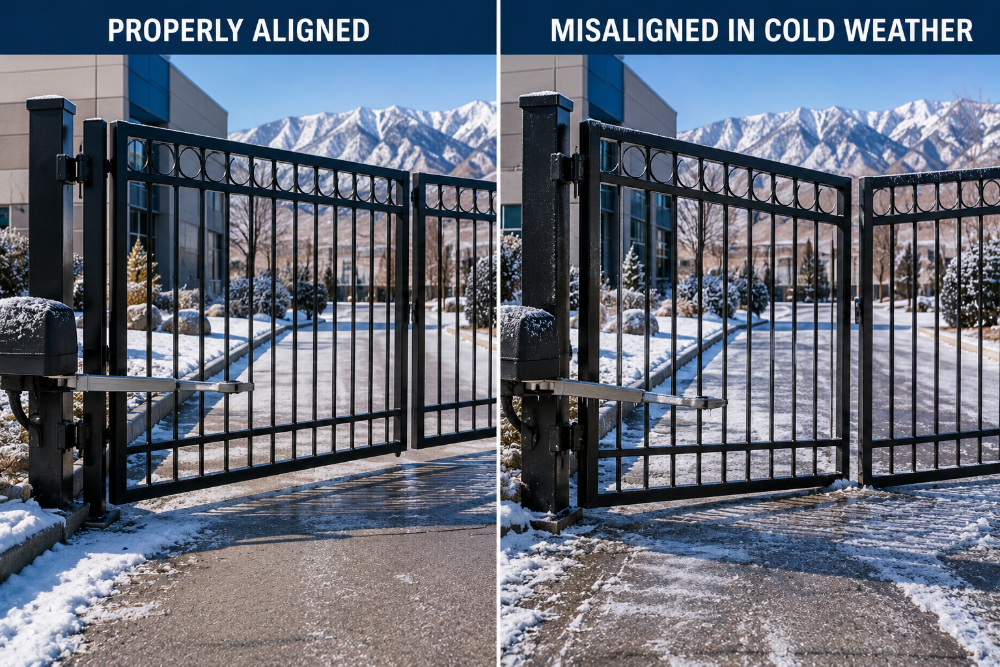
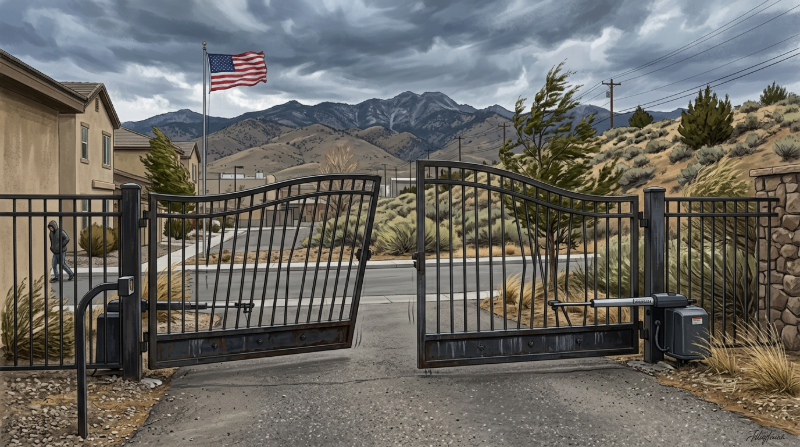
For automatic gates, post movement creates cascading problems. On swing gates, shifted posts change hinge geometry. The gate may bind partway through its travel, drag at the bottom, or fail to meet the latch cleanly. On slide gates, post movement can shift rack alignment so the operator pinion binds against the rack or rides out of engagement.
Posts set shallow are more vulnerable. General guidance for cold climates recommends setting posts below the frost line with adequate footing size. Posts that do not reach sufficient depth or sit in undersized concrete are prone to frost heave. Poor drainage around posts makes the problem worse by allowing water to accumulate where it can freeze.
The concrete itself can also deteriorate. Older footings or those without proper air entrainment can spall and crumble under repeated freeze-thaw stress. When the footing weakens, it allows micro-movement under the loads that operators apply during each cycle. That movement accumulates into alignment problems that show up as operational symptoms.
Hinge Wear and Failure Patterns
Hinges on automatic swing gates take punishment from both freeze-thaw and wind, often simultaneously.
Moisture and temperature cycling cause corrosion inside hinge barrels and around pins. Lubricants thicken or break down in cold temperatures, increasing friction. When an operator pushes a gate through hinges that are not moving freely, it draws more current and applies more torque to internal gears.
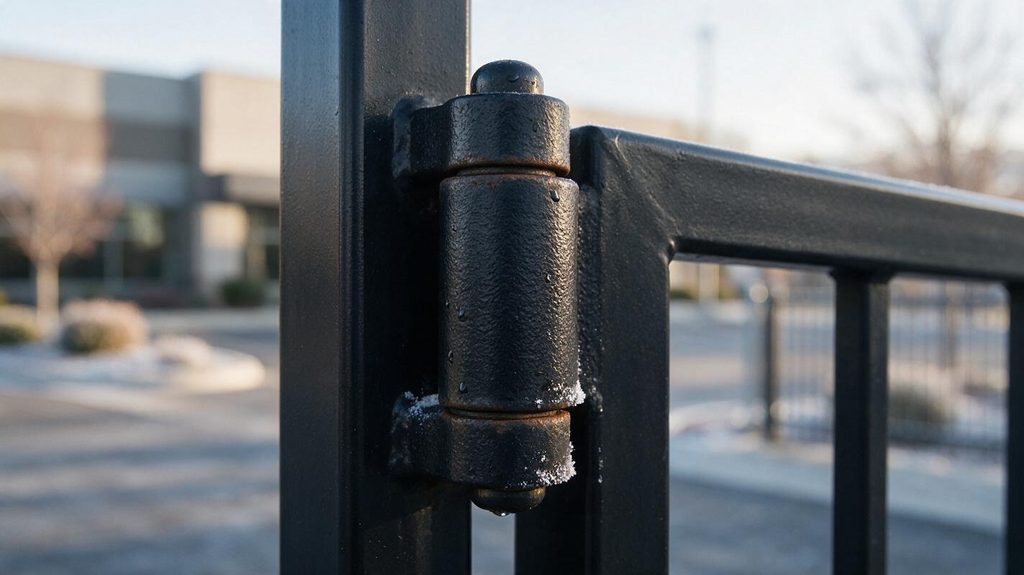
Freeze-thaw also loosens hinge fasteners. As posts move microscopically with frost, bolts and brackets shift. Over time, bolt holes can oval out. Brackets can bend slightly under repeated stress. These changes are often too small to notice on casual inspection but accumulate into measurable misalignment.
Wind compounds the problem. Repeated gusts apply side loads that stress hinges in ways they were not primarily designed to handle. Cyclic loading fatigues welds at hinge plates and can gradually bend brackets, changing the geometry the gate needs to operate smoothly.
When hinges wear or misalign, the gate may drag at the bottom or bind at certain points in its swing. The operator works harder to move the gate, which stresses the motor, gearbox, and limit switches. Safety systems may trip more frequently as the gate encounters unexpected resistance.
Track and Roller Problems on Slide Gates
Slide gates face a different set of freeze-thaw vulnerabilities centered on the track system and rolling hardware.
Ground movement from frost heave can push tracks out of level. A track that develops high spots or low spots causes rollers to climb, bind, or derail. When alignment is compromised, the operator strains to pull the gate through sections where it should roll freely.
Debris accumulates in V-tracks more readily when freeze-thaw is crumbling nearby concrete or heaving soil. Grit and sediment grinding between rollers and track accelerates wear on both. Roller bearings that run in contaminated tracks develop play and roughness faster than those in clean systems.
Ice and snow accumulation on tracks reduces clearances and can interfere with motion directly. When alignment is already marginal from ground movement, even a small amount of ice buildup can cause binding or derailment.
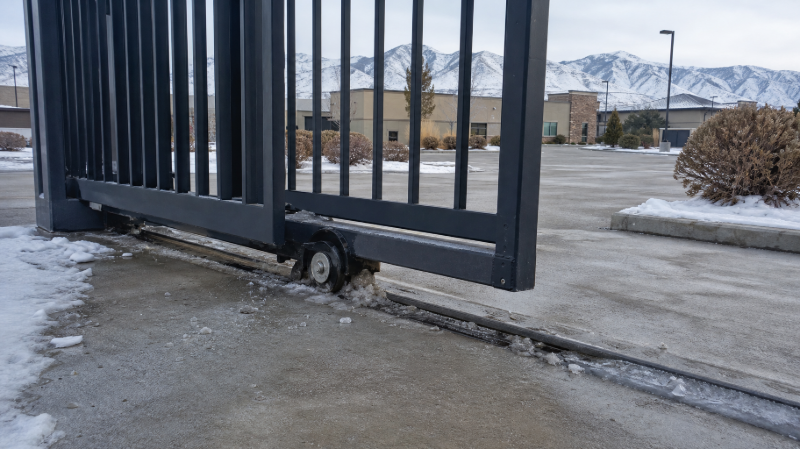
Rack and pinion systems on slide gates depend on consistent alignment between the rack mounted to the gate and the pinion gear on the operator. When the post supporting the operator shifts from freeze-thaw, that alignment changes. The pinion may bind against the rack, skip teeth, or ride at an angle that accelerates wear.
How Wind Exploits Existing Weaknesses
Wind damage to automatic gates is not primarily about a single catastrophic event. It is about repeated loading that exploits weaknesses created by freeze-thaw or installation shortcomings.
When wind pushes against a gate panel, the force transfers through the gate frame into hinges, posts, and operators. Solid panels catch more wind than open designs. Wider gates create longer lever arms that multiply torque on posts.
For swing gates, wind during operation can oppose the gate’s motion or accelerate it depending on direction. Opening into the wind increases motor load and torque on gears. Wind-assisted closing increases impact on mechanical stops and latches. Either condition can cause nuisance trips on obstruction sensing as the operator detects unexpected resistance or acceleration.
For slide gates, crosswinds create side loads on rollers and track. If alignment is already compromised by freeze-thaw, wind can push the gate into binding conditions or cause oscillation on the rollers that accelerates bearing wear.
The pattern I see in Reno installations is that freeze-thaw moves and weakens the support system, then wind exploits that weakness. A gate with solid footings and properly aligned hardware handles wind loading without progressive damage. A gate with posts that have shifted slightly takes more stress from wind, which loosens fasteners further, which allows more movement from the next freeze-thaw cycle.
The Progression of Seasonal Damage
Understanding how damage accumulates helps explain why some gates fail earlier than expected and why symptoms often worsen after winter.
In the first winters after installation, freeze-thaw causes small shifts in post plumb and footing stability. Corrosion begins at hinges and base plates where moisture sits. These changes may not produce noticeable operational symptoms yet.
During wind seasons, strong gusts apply side loads to posts and hinges that have been slightly compromised. Fasteners begin to loosen. Hinges or brackets may bend incrementally.
Operational symptoms emerge as the gate no longer closes into latches cleanly. Auto-close may misalign. Operators begin to strain, stall, or stop mid-travel, especially in cold weather when lubricants are thick and components are contracted. Slide gates may bind on track high points or derail under wind-assisted motion.
Long-term outcomes include significant gate sag, visible post lean, and persistent misalignment. Operators fail prematurely from sustained overload rather than from their own defects.
This progression explains why replacing an operator alone often does not solve the problem. If the posts and hinges are not corrected, a new operator just moves the failure point forward in time.
Variables That Affect Damage Severity
Not every automatic gate in Reno experiences the same level of seasonal damage. Several factors determine how hard freeze-thaw and wind hit a particular installation.
Footing design and depth matter most. Posts set below local frost depth with adequate concrete and proper drainage resist movement significantly better than shallow or undersized footings.
Panel design affects wind loading. Solid panels catch more wind and transfer more force into structural components. Open designs reduce wind load on posts and operators.
Gate width and weight amplify torque on posts and hinges, especially under wind. Wider, heavier gates are inherently more demanding on their support systems.
Slope and grade at the driveway increase mechanical loads on hinges and operators even before climate factors come into play. Steep driveways stress hardware during every cycle.
Maintenance practices make a measurable difference. Annual inspection of post plumb, hinge torque, track condition, and alignment after winter helps catch early movement before it becomes severe. Small adjustments made early can prevent the cascading failures that follow when problems are ignored.
System-Level Thinking for Reno Conditions
The practical takeaway from understanding these damage mechanisms is that automatic gates in Reno need to be evaluated as integrated systems, not as collections of independent parts.
When a gate starts misbehaving after winter, the instinct is often to look at the operator first because that is what is making noise or throwing errors. But the operator is usually responding to conditions created elsewhere in the system. Post movement, hinge wear, track misalignment, and accumulated debris all increase the load the operator has to overcome.
Effective diagnosis means checking post plumb, footing integrity, hinge condition, track alignment, and operator limits together. A gate that has been through several Reno winters deserves inspection at each of these points, not just at the component that is currently showing symptoms.
For new installations, the same understanding points toward what matters most in design and construction. Footing depth, drainage, hardware sizing, and panel design choices all affect how well the gate will hold up under the specific combination of freeze-thaw and wind that Reno delivers.
Working With Reno’s Climate
Automatic gates in Reno operate in conditions that test every part of the system over time. Freeze-thaw cycles move posts, deteriorate footings, and wear hinges. Wind loads exploit those weaknesses and accelerate mechanical wear. The combination creates a pattern of progressive damage that explains why gates often develop problems gradually rather than failing suddenly.
At A1 Fence LV, Zachary Thompson evaluates automatic gate systems with Northern Nevada’s climate conditions in mind. His experience across fabrication, installation, and operator integration has given him a practical understanding of what holds up under Reno’s seasonal conditions and where problems are more likely to develop. Understanding the causes of seasonal damage allows him to help property owners make informed decisions about system design, maintenance timing, and repair priorities.
If you are evaluating options for an automatic gate or diagnosing problems with an existing system, you can request a quote online at https://a1fencelv.com/request-a-quote. For properties dealing with winter damage or planning an installation that needs to perform reliably through Reno’s changing seasons, Zachary can help evaluate the site and determine what makes sense for the property’s conditions and operating needs. He can also be reached directly at (702) 904-5998 or zac@a1fencelv.com.