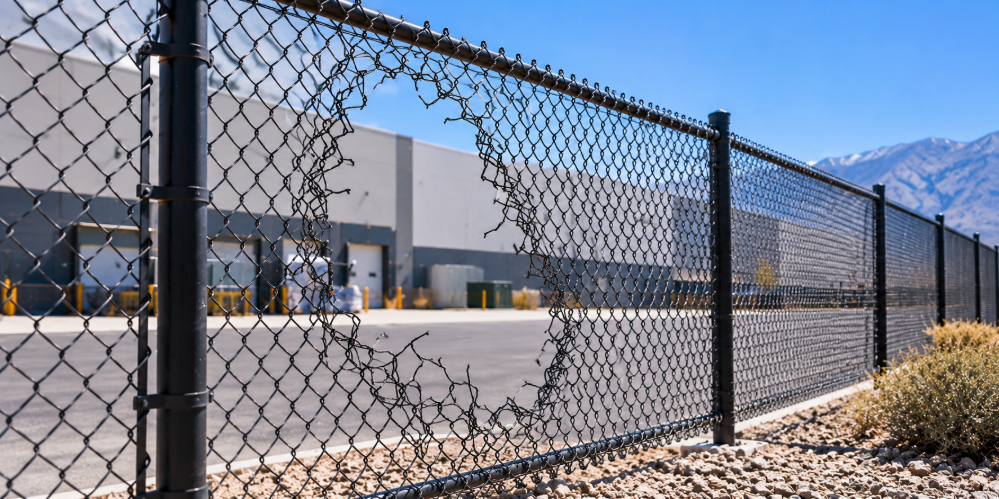
Cut or vandalized chain link fabric creates an immediate security gap on commercial properties. Whether the damage involves a few severed diamonds or a larger section pulled back to create unauthorized access, the repair approach depends on the size and location of the opening, the condition of surrounding structural components, and the security requirements of the affected perimeter.
For property managers, facilities directors, and general contractors in Las Vegas, understanding what these repairs involve helps with accurate scoping, realistic scheduling, and proper coordination with fence contractors. This article covers the practical repair methods, the structural factors that often accompany fabric damage, and the coordination considerations that apply to commercial sites. For broader context on fence repair across commercial applications, that resource provides additional background.
How Vandalized Chain Link Fabric Typically Presents
Damage to chain link fabric on commercial properties generally falls into recognizable patterns. Small cuts or holes appear where wire has been clipped with bolt cutters, often affecting only a few diamonds in the mesh. Larger, irregular openings result from fabric being cut out or pulled back to create access points for unauthorized entry.
In some cases, the mesh itself remains relatively intact, but ties connecting the fabric to the top rail, line posts, or bottom tension wire have been severed. This allows the fabric to be lifted or pushed aside even without significant cutting. Combined damage is also common, particularly from forced entry or vehicle impact, where bent posts, displaced rails, and compromised tension components accompany the fabric breach.
The repair method selected depends primarily on how much fabric is affected, whether the damage occurs at a panel edge or mid-span, and whether structural elements beyond the mesh need attention.
Localized Weave-In Repairs for Small Cuts
When damage is confined to a relatively small area and surrounding fabric remains structurally sound, a localized patch repair is often appropriate. This approach preserves the continuity of the existing mesh rather than replacing an entire section.
The process begins by cutting out the damaged diamonds to create a clean, rectangular opening rather than leaving jagged edges. A matching patch panel is then prepared from new fabric or salvaged material of the same gauge and mesh size. A single wire strand, sometimes called a corkscrew wire, is unweaved from the patch or a roll of matching fabric.
The patch is positioned within the opening, and the loose strand is threaded through the interlocking diamonds of both the existing fence and the patch. This effectively recreates the original knuckle pattern that gives chain link its structural integrity. The ends are then closed at top and bottom to complete the mechanical lock.
This method works well for modest openings that are not located at panel edges. It maintains mesh continuity and avoids the more extensive work required for full-section replacement.
Full-Section Fabric Replacement for Larger Damage
When cuts are large, irregular, or when vandalism has compromised tension over several feet of fence line, full-section replacement is typically necessary. This is the predominant method for vandalism-related cut-outs along secure perimeters.
The damaged section is first detached by removing tie wires connecting the fabric to the top rail, line posts, and any bottom tension wire or security cable. If a tension bar and bands are present at a terminal post, tension is relieved using a fence stretcher or puller before proceeding. Intact wires just outside the damaged area are identified, and strands are untwisted to free the compromised section.
Replacement fabric is measured and cut to match the existing fence in height, mesh size, and wire gauge. The replacement is typically cut slightly longer than the removed section, often by one or two diamonds, to allow proper stretching and alignment during installation.
The new fabric is hung temporarily from the top rail with loose wire ties to hold alignment while connection work proceeds. Saved or new strands are woven through the knuckles of old and new fabric on each side of the opening. A stretcher bar and come-along or fence stretcher then pulls the fabric tight until mesh flex falls within acceptable limits.
Once tensioned, the fabric is retied to the top rail, line posts, and bottom tension wire at standard spacing. Commercial applications often specify tie spacing between 12 and 24 inches depending on security requirements for the perimeter.
Structural Repairs That Typically Accompany Fabric Damage
Vandalism or forced entry frequently affects more than the fabric itself. Bent or loose posts may require excavation around the base, straightening with mechanical leverage, or full replacement with new concrete footings. For situations where immediate repair is not feasible, temporary bracing can maintain continuity until permanent work is scheduled.
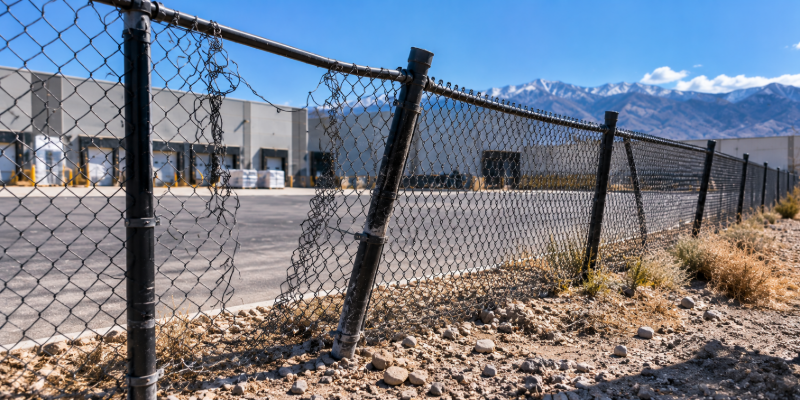
Damaged or sagging top rails are cut out and replaced with new sections, reconnected via couplings and brace bands. Loose or misaligned rails are refastened and bolts tightened to restore proper line and stiffness. Compromised ties and bottom tension wire allow fabric to be lifted even after mesh repairs are complete. These must be replaced with appropriate commercial-grade ties or hog rings, and any security cable needs rethreading through lower diamonds with reconnection at terminals.
On commercial properties, these structural elements are typically treated as part of the same repair scope. Leaving sagging rails or weakened posts in place undermines the value of fabric replacement and leaves the perimeter vulnerable to further breach.
Matching Existing Specifications
Commercial fences are usually specified for particular height, gauge, coating type, and mesh size. Repairs need to match these characteristics to avoid creating weak or noncompliant segments that become obvious target points for further tampering.
Using mismatched gauge or mesh size can create visible weak seams in the fence line. Ad-hoc lacing without proper weaving and tensioning creates stress concentrations that can fail under load or additional tampering. Where the fence is part of a contracted project, repair work should align with original plans and specification sheets to maintain consistency across the installation.
Property managers coordinating repairs should provide contractors with existing specifications when available. For older installations where documentation may not exist, a site assessment by the contractor can identify the characteristics that need to be matched.
Security and Operational Coordination
For commercial properties, fabric repair is not purely a technical task. Cut fabric can provide direct access to equipment yards, storage areas, or occupied buildings. Repairs are often scheduled as priority work to close security gaps quickly.
Temporary measures such as wire lacing or zip ties may provide short-term closure, but standard practice calls for permanent fabric replacement to follow promptly. Relying on temporary repairs for extended periods leaves the perimeter in a compromised state.
Property managers often require documented extent of damage, repair method, materials used, and before and after photos for incident files and insurance purposes. On multi-tenant or active construction sites, specific access protocols, safety requirements, and scheduling constraints may apply to work near parking lots, equipment yards, or public-facing boundaries.
Coordination with the contractor should address these documentation and access requirements before work begins. For sites with active operations, scheduling repair work during low-traffic periods can minimize disruption while allowing proper execution.
Las Vegas Code Considerations for Chain Link Repairs
Local land use rules in Las Vegas influence where chain link fencing can be used and how modifications are viewed, particularly near public frontages. Some zoning and landscape standards identify chain link or open wire fencing as unacceptable for permanent screening or perimeter walls in certain contexts, allowing it primarily as temporary construction fencing.
Height limits for fences and walls in office and commercial zones also apply, with provisions in areas like North Las Vegas referencing limits up to 10 feet depending on location and zoning classification.
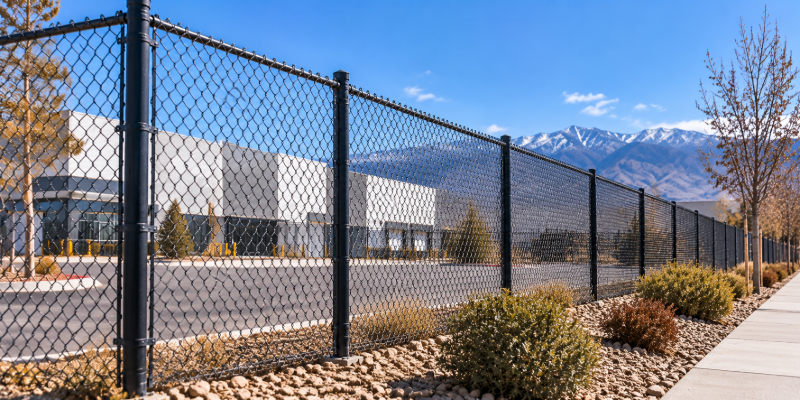
For existing, legally established chain link installations, repair work generally focuses on restoring existing conditions rather than changing fence type. Emergency repair to maintain security is typically treated differently from new construction. However, work that substantially alters the fence, such as raising height, adding new stretches, or changing use, may require coordination with local planning or building departments to confirm current requirements.
A contractor familiar with commercial fence work in the Las Vegas market will generally verify whether the affected segment is part of a grandfathered installation and can advise if the damage triggers broader compliance considerations beyond straightforward repair.
Factors That Drive Repair Decisions
Several variables materially affect how commercial fabric repairs are scoped and executed. The size and type of opening determines whether localized patching is sufficient or whether longer runs should be replaced to avoid ongoing weak points. Repeated cuts in the same area often justify replacing a larger section rather than patching multiple times.
The security classification of the area matters significantly. Higher-security zones such as utilities, critical infrastructure, or sensitive storage often require full-standard repairs with matching gauge, correct tensioning, and adherence to specified attachment standards.
The condition of surrounding fence influences whether spot repairs make sense or whether consolidating into a larger refurbishment scope is more practical. If nearby fabric, posts, or rails are already degraded from corrosion or prior impacts, addressing multiple issues together can be more efficient than handling them separately.
Access and site constraints also shape the work. Adjacent traffic, utilities, existing structures, and operational schedules can dictate working time windows, equipment selection, and staging requirements. For properties experiencing repeated vandalism, the cost-benefit calculation may shift from spot repairs toward section replacement or material upgrades such as privacy slats, anti-climb measures, or heavier gauge fabric.
The Chain Link Fence Manufacturers Institute notes that commercial and high-security chain link systems can use heavier wire and smaller mesh sizes to improve resistance to cutting and unauthorized access, making proper repair important when the fabric has been compromised.
Working with a Commercial Fence Contractor
Effective repair of vandalized chain link fabric requires accurate assessment of both the visible damage and any underlying structural compromise. For commercial properties in Las Vegas, the combination of security urgency, specification matching, and coordination requirements makes contractor selection and communication particularly important.
A1 Fence LV works with property managers, general contractors, and facilities teams throughout the Las Vegas Valley on commercial fence repair and installation. The company brings experience coordinating within structured project environments and can assess damage, match existing specifications, and execute repairs that restore perimeter integrity.
If you are evaluating repair options for a current security concern or coordinating a broader maintenance scope, you can request a quote online at https://a1fencelv.com/request-a-quote, call 702-504-0765, or email lalo@a1fencelv.com. Submitting the online request form is the simplest starting point for teams ready to move forward.